
Gold and silver prices fell sharply Wednesday, Oct. 14, as stronger-than-expected U.S. inflation figures raised expectations of another interest rate increase by the U.S. Federal Reserve, putting pressure on precious metals markets and Canadian mining shares.
In Canadian dollars, gold closed at approximately $5,845 per troy ounce, down 1.1 per cent, while silver dropped 5.8 per cent to $79.23. On U.S. futures markets, gold settled at $4,084.80 US, down 1.6 per cent, while silver plunged 6.1 per cent to $55.55 US.
The selloff followed U.S. inflation data showing consumer prices increased 3.7 per cent annually in September, slightly above expectations. Higher interest rates generally make precious metals less attractive because neither gold nor silver pays interest.
Early market trading this morning had gold trading at $5,890 and silver at $80.18.
Wednesday’s downturn followed several months of fluctuating prices.
In Canadian dollars, gold averaged approximately $5,748 an ounce in July before climbing to $6,132 in August. The average eased to $6,039 in September, followed by Wednesday’s decline to $5,845.
Silver experienced greater volatility, averaging $82.95 an ounce in July, $90.89 in August and $90.19 in September. Wednesday’s close of $79.23 placed silver below its July average and nearly $11 below its September average.
Despite the recent declines, gold remained slightly above its July average, while silver had surrendered considerably more ground.
Adding to the uncertainty is the struggling Canadian dollar, which has weakened against its American counterpart.
According to the Bank of Canada, the loonie was worth approximately 70.11 cents US on Oct. 14, compared with 71.90 cents a month earlier. Canadians consequently needed approximately $1.43 to purchase one U.S. dollar.
Because gold and silver trade internationally in U.S. dollars, a weaker Canadian currency can partially cushion falling bullion prices when converted into Canadian dollars. However, it also increases costs for Canadian collectors and dealers purchasing coins, bullion and collecting supplies from American suppliers.
The downturn also weighed on Canadian mining shares. The S&P/TSX Composite Index fell 1.1 per cent Wednesday, while its materials sector declined 4.3 per cent. Canada is a major gold producer, with production valued at $16.9 billion in 2024 and gold exports reaching $40.2 billion, according to Natural Resources Canada.
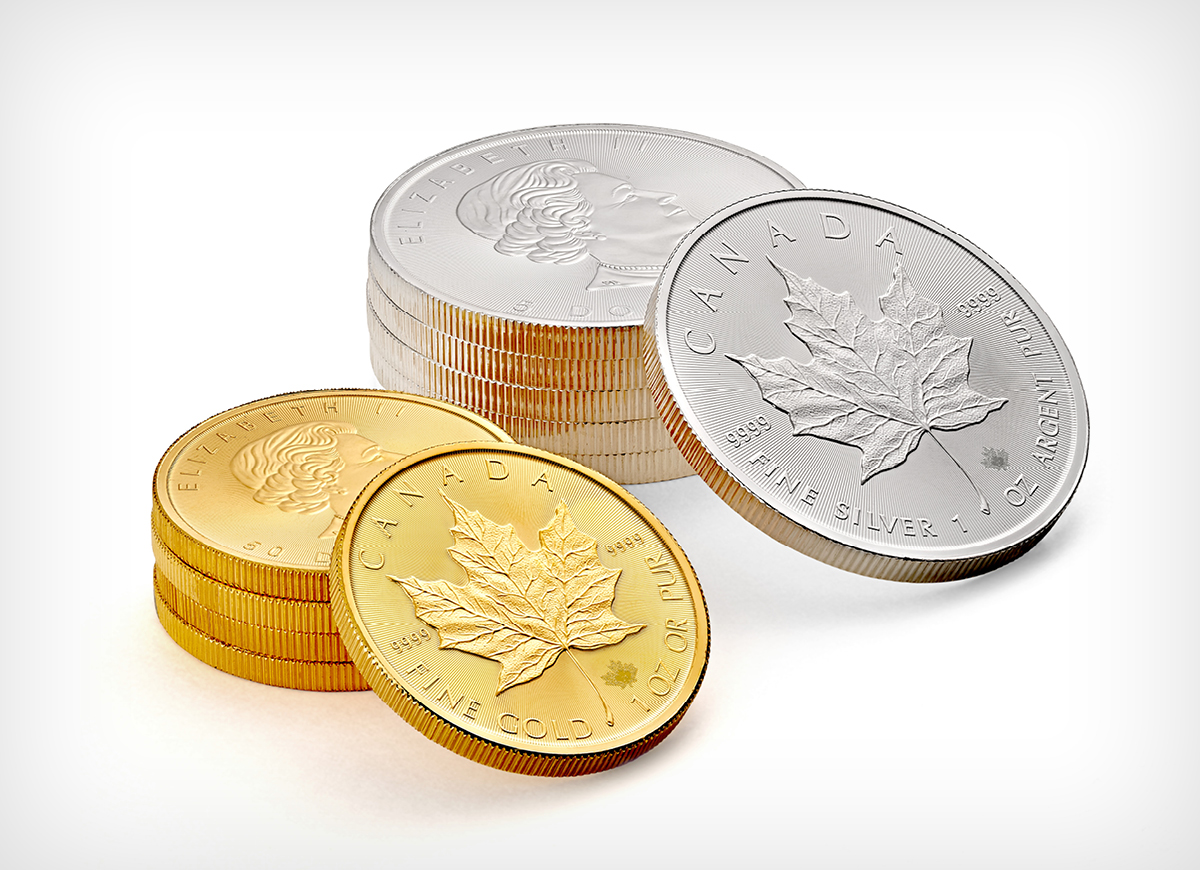
For Canadian collectors, declining bullion prices directly affect products such as the Royal Canadian Mint’s Gold and Silver Maple Leafs, along with common-date pre-1968 Canadian silver coins valued primarily for their metal content.
However, collectible coins carrying significant numismatic premiums may be less affected, with condition, scarcity and collector demand remaining important factors.
For dealers, rapidly changing bullion prices, fluctuating exchange rates and retail premiums complicate purchasing and inventory decisions.