
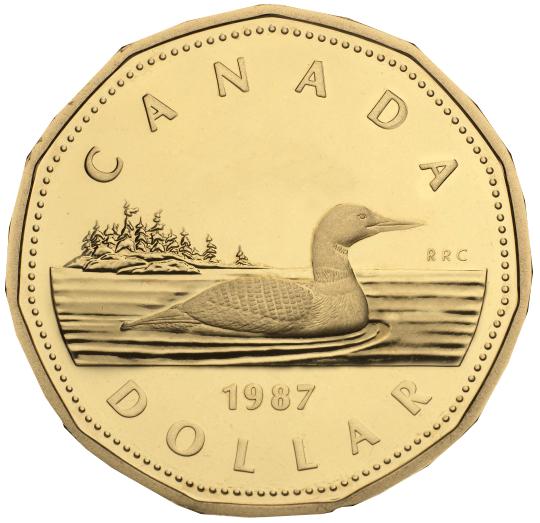
The Common Loon, one of Canada’s most recognizable wildlife symbols and the bird featured on the country’s $1 circulation coin for nearly four decades, is experiencing substantial declines in breeding success across much of its North American range, according to a major scientific study.
The findings raise concerns about the future of a bird whose distinctive call has become synonymous with Canada’s wilderness and whose image has become an enduring symbol of Canadian identity.
In an Oct. 22 report published in The Globe and Mail, science reporter Ivan Semeniuk detailed the findings of a three-year study involving more than 20 researchers from Canada and the United States. Published in the scientific journal FACETS, the research found substantial long-term declines in loon breeding productivity in 11 of 12 regions examined, with the steepest declines occurring in Atlantic Canada and the Prairie provinces. Matthew Fuirst, a research ecologist with Birds Canada who led the study, told The Globe the findings suggest loons are facing significant challenges across much of their breeding range.
As Semeniuk reported, researchers examined more than 45,000 breeding records collected at 3,421 lakes across North America, including observations submitted by volunteers participating in Birds Canada’s long-running loon survey. The study measured breeding productivity by tracking the number of chicks per adult pair surviving beyond six weeks after hatching. Declines generally ranged from 0.5 to 2.5 per cent annually over periods spanning two to four decades. Northern Maine was the only region studied where productivity remained relatively stable.
Although the Common Loon is not currently considered endangered, Semeniuk reported Canada supports an estimated 254,000 breeding pairs, representing approximately 94 per cent of the species’ population. Scientists suspect several factors may be contributing to the declines, including shoreline development, human disturbances and climate-related changes in precipitation. Increased rainfall and runoff can reduce water clarity, making it more difficult for loons to catch fish and feed their young. Walter Piper, a biology professor at Chapman University in California and a study co-author, cautioned the effects of declining reproductive success may take years to become apparent because loons are long-lived birds.
For Canadian numismatists, the bird’s significance extends well beyond its natural habitat. The Common Loon became a national icon in 1987 when the Royal Canadian Mint introduced Canada’s new $1 circulation coin to replace the familiar $1 banknote. The 11-sided, aureate-bronze-plated nickel coin featured a loon swimming on a lake, a design created by Canadian wildlife artist Robert-Ralph Carmichael. Although Canada had issued silver dollars beginning in 1935, the 1987 coin was the first dollar intended to replace the banknote in everyday commerce. Canadians quickly embraced the nickname “loonie,” which became part of the national vocabulary.
Interestingly, the loon was not the Mint’s original choice for the new coin. The initial design was intended to feature Emanuel Hahn’s iconic Voyageur image, previously used on Canada’s silver and nickel dollars. However, the master dies for the proposed Voyageur coin disappeared while being transported, prompting the Mint to adopt Carmichael’s loon design instead. (Check out this link for a story on the mysterious disappearance of the master dies.) What began as an unexpected design change became one of the most recognizable images in Canadian numismatics. The coin has since undergone several changes in composition, including the introduction of multi-ply plated steel in 2012, but the loon remains the standard reverse design on Canada’s circulating dollar.
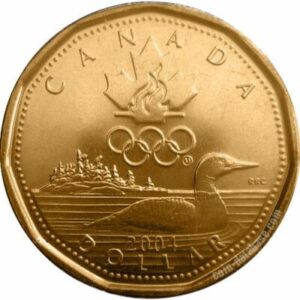
The Royal Canadian Mint issued this special $1 circulation coin in 2004 to celebrate Canada’s Olympic athletes. Featuring a loon with the Canadian Olympic Committee’s maple leaf symbol, the coin continued the Lucky Loonie tradition born at the 2002 Salt Lake City Winter Olympics, where a Loonie buried beneath centre ice became a good-luck symbol for Canada’s gold-medal-winning hockey teams.
The loonie’s place in Canadian culture was further cemented during the 2002 Winter Olympics in Salt Lake City, Utah, when Canadian icemaker Trent Evans secretly embedded a $1 coin beneath centre ice at the hockey arena as a good-luck charm for Canada’s teams. Both the men’s and women’s hockey teams went on to capture gold medals, with the men’s victory ending a 50-year Olympic gold-medal drought. The story of the “Lucky Loonie” quickly became part of Canadian sporting folklore, transforming an everyday circulation coin into a symbol of national pride and athletic achievement.
The tradition proved so popular that the Royal Canadian Mint introduced its first commemorative Lucky Loonie circulation coin in 2004 to support Canadian athletes competing at the Athens Summer Olympics. Subsequent issues celebrated Canada’s participation in Olympic and Paralympic Games, often featuring variations of the familiar loon design alongside Olympic symbols. The original 2002 coin eventually found a home in the Hockey Hall of Fame, while the tradition of placing loonies beneath playing surfaces spread to other sports, including curling. The Mint has continued celebrating the tradition, including a special 2026 Lucky Loonie featuring a loon with its wings raised in a V-shaped display of victory.
The latest scientific findings add a sobering dimension to the bird’s place in Canadian culture. As Semeniuk explained in The Globe and Mail, researchers believe the widespread declines may signal broader environmental pressures affecting lakes across North America. Piper warned the study could be identifying the early stages of a longer-term population decline, while Fuirst and his colleagues are continuing their investigations into the underlying causes. Their work underscores the importance of understanding environmental changes before the consequences become more severe.
Nearly 40 years after its introduction, the loonie remains one of Canada’s most familiar coins, connecting the country’s natural heritage, numismatic history and sporting achievements. From the lakes depicted on Carmichael’s original design to the Olympic hockey victories associated with the Lucky Loonie, the bird has earned a lasting place in Canada’s national identity. While its image remains secure on the country’s $1 coin, the research reported by The Globe and Mail serves as a reminder that protecting the living symbol behind the loonie may prove considerably more challenging.
The study’s findings underscore the need for stronger conservation efforts and continued research into the factors contributing to declining loon populations. Researchers have identified widespread declines across much of Canada, raising concerns about the long-term health of a species closely associated with the country’s lakes and wilderness. Continued monitoring, improved understanding of environmental pressures and efforts to protect breeding habitats will be important in addressing the declines.
Birds Canada encourages boaters to reduce their speed near nesting areas, anglers to avoid lead-based fishing tackle and volunteers to participate in its Canadian Lakes Loon Survey. The Federation of Ontario Cottagers’ Associations (FOCA) also promotes healthy shorelines, encouraging waterfront property owners to preserve natural vegetation, maintain buffers of native plants along the water’s edge, limit the removal of trees and shrubs and minimize shoreline development. These measures help protect nesting habitat, reduce disturbances and maintain the water quality essential to healthy loon populations.