
Editor’s update: The note sold for $91,519 US (about $125,381 CAD), including buyer’s premium. It had an original estimate of $30,000+ US.
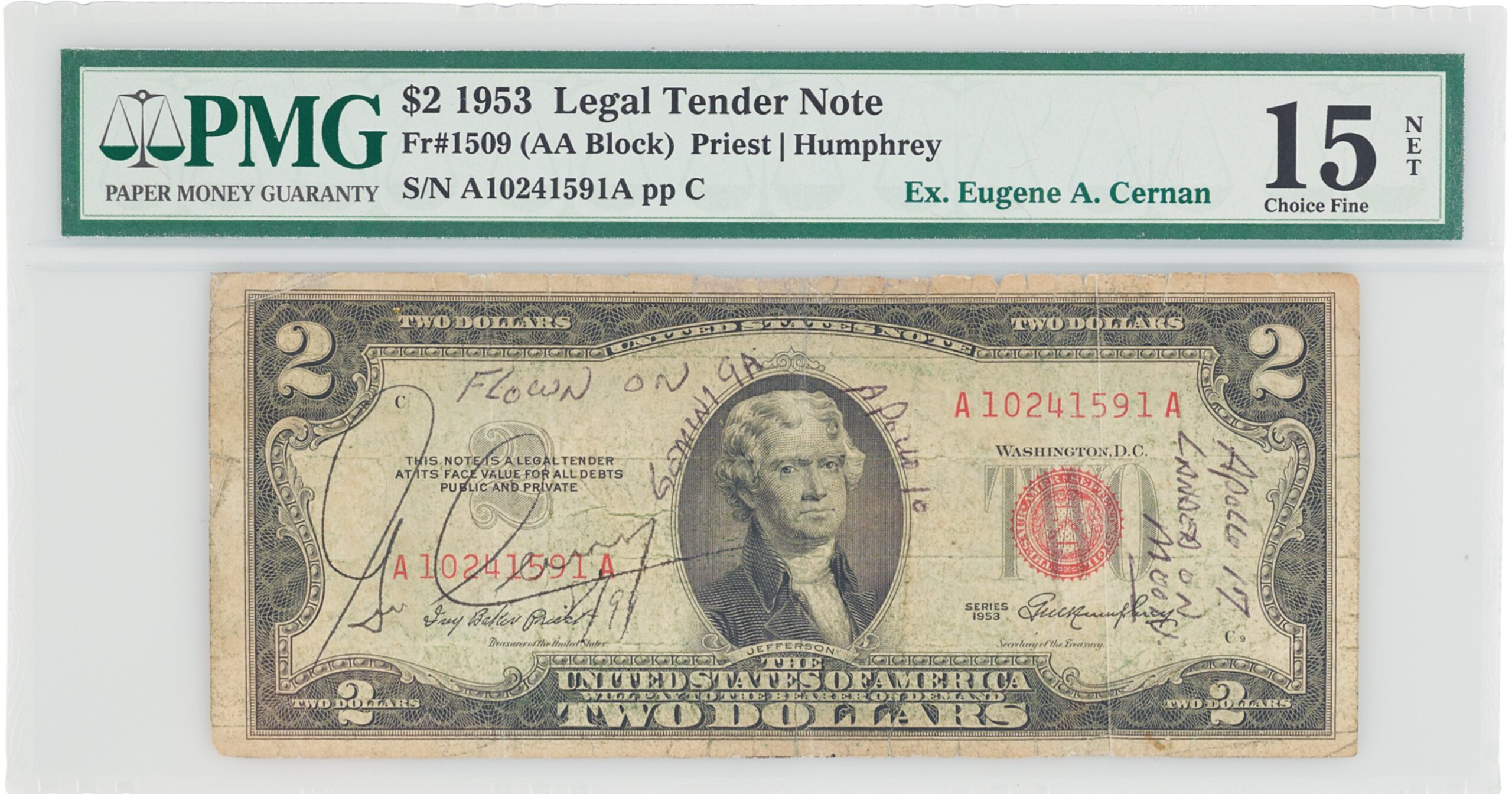
A Series 1953 $2 United States note carried by astronaut Gene Cernan on three historic NASA missions, including the final lunar landing, is drawing strong early bidding in an April sale by RR Auction.
As of 8 a.m. April 16, the note had attracted 13 bids, reaching $41,327 US (about $56,000 CAD).
The note, serial number A10241591A, is signed and flight-certified by Cernan on the portrait side, reading: “Flown on Gemini 9A, Apollo 10, Apollo 17, Landed on Moon, Gene Cernan.” It has been encapsulated by PMG with a grade of Choice Fine 15 and is offered with extensive documentation and provenance.
Described as one of the most unique examples of space-flown currency, the note was carried by Cernan on three separate missions spanning the Gemini and Apollo programs. Its significance lies in its documented presence across three distinct phases of human spaceflight: low Earth orbit, lunar orbit and the lunar surface.
According to a signed letter of provenance included with the lot, the note originally belonged to Cernan’s father. After his father’s death in 1967, Cernan carried the bill with him for luck and in memory on each of his spaceflights.
During Gemini 9A in June 1966, his first mission, the note was carried into low Earth orbit and exposed to the vacuum of space during an extravehicular activity. It later accompanied Cernan aboard Apollo 10 in May 1969, a full dress rehearsal for the Moon landing, during which the spacecraft descended to within 8.4 nautical miles of the lunar surface and spent more than two days in lunar orbit.
The note ultimately reached the Moon during Apollo 17 in December 1972, when Cernan commanded the final lunar landing mission of the Apollo program. Carried aboard the lunar module Challenger, it remained on the surface in the Taurus Littrow valley for more than three days.
Supporting material included with the lot features photographs of Cernan with the note, a copy of the Apollo 17 personal preference kit inventory listing the item and additional archival documentation.
The bill is also linked to a broader milestone in spaceflight history. Apollo 10, one of the missions on which it travelled, set the record for the highest speed achieved by a crewed vehicle during its return to Earth, reaching 24,791 miles per hour (39,897 km/h).
With its combination of personal provenance, documented flight history and direct connection to humanity’s final lunar landing mission, the note represents a rare intersection of numismatics and space exploration, one unlikely to be duplicated.